The Vault Market: Turning 45 Church Into New Haven’s All-Day Public Living Room
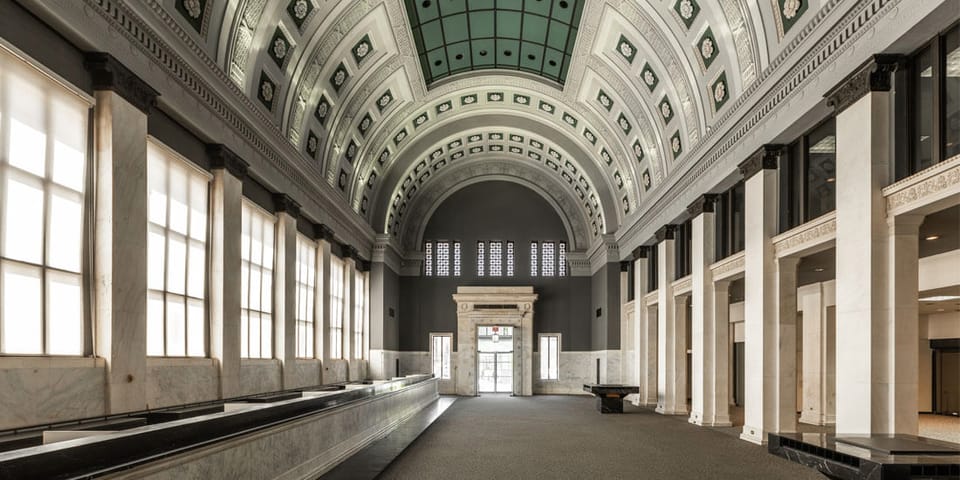
A downtown market hall in a landmark building—food stalls, vendors, daylight, and a real reason to be in the city between meals.
Quick Stats
- Location: Downtown New Haven — 45 Church Street (former marble bank)
- Category: Food / Retail / Public Market
- Stage: Concept — needs founder / operator
- Capital Intensity: Medium to High (depends on renovation scope)
- Complexity: Multi-partner, small team operator
- Time to First Opening: ~6–12 months from “go,” depending on buildout
1. The Opportunity
If New Haven had an everyday landmark—somewhere you could drift through for coffee, lunch, a snack, a random local purchase, or just the pleasure of being around other humans without planning your life around it—what would it be?
Most cities that feel culturally “complete” have a market hall like this. San Francisco has the Ferry Building. Seattle has Pike Place. Smaller cities have their own versions. These places aren’t just food halls; they’re civic living rooms. They’re open most of the day, they’re in iconic buildings, and they give downtown a heartbeat outside of nightlife.
New Haven doesn’t really have that. We have great restaurants, farmers markets for a few hours a week, and pop-ups that come and go. But we don’t have a stable, all-day downtown market commons that you can rely on any random Tuesday at 2pm. And for a city with this much food talent and daily foot traffic, that gap feels weird.
Which is why 45 Church Street keeps sticking in my head. It’s a gorgeous old marble bank building that’s been vacant for years. The main floor is about 12,500 square feet, with 48-foot ceilings, historic vaults, and architectural details that make it feel like the city accidentally built a cathedral for commerce. It’s downtown. It’s walk-by traffic all day. It’s the kind of space that, once you’ve seen it, makes you think: this should be full of people.
Right now it isn’t. And that feels like a waste of a cultural asset.
2. The Concept (In Plain Language)
The simplest version of the idea is: turn 45 Church into New Haven’s market hall.
Not a once-a-week pop-up. Not a seasonal experiment. A real, daily-use place that’s open most of the day and gives people a reason to be downtown even when they’re not going to a restaurant.
You build out a set of small stalls and shared seating, then curate a mix that fits how New Haven actually lives. Coffee and baked goods early. Lunch options that don’t require a formal sit-down. Afternoon hang energy. Maybe a few simple dinner options into the evening. A couple specialty retail stalls supporting local producers—pantry goods, flowers, books, whatever makes sense without turning it into an airport food court.
Some vendors would be permanent anchors so people form habits. Some would rotate so the place stays alive and surprising. The building brings the drama for free; the operator’s job is to make the mix feel local, daily-use, and not precious.
If this works, it becomes a place you don’t have to plan. You just go. “Meet me at the market” becomes a normal sentence.
3. Why This Belongs in New Haven
We’re a food city hiding inside a fragmented daily routine.
New Haven has tons of cooks, vendors, and small operators who would thrive in a stable, high-traffic home. We have nonstop daily demand downtown: students, staff, Yale medical and research folks, courthouse people, office workers, residents, visitors. Those people already flow through this area all day. They just don’t have one reliable, daylight-friendly anchor that lets them linger.
A market hall fixes that because it gives downtown a default human reason to exist there without an agenda. It pulls people in between meals, between classes, between errands. It makes the city feel less transactional and more communal.
And then there’s the building itself. Cities don’t get many chances to turn a landmark structure into something culturally important and economically useful. If 45 Church becomes a market, it isn’t just a tenant—it’s part of New Haven’s identity.
4. Who This Is For
On the customer side, this is for pretty much anyone who uses downtown during daylight hours.
It’s for downtown workers who want coffee and lunch options that aren’t a full sit-down commitment. It’s for students who need a place to hang, study, meet friends, or eat something good without having to “go out.” It’s for Yale medical and research folks who already move through Church Street all day. It’s for residents who want a reliable “I’ll just go there and see what looks good” option. And yes, it’s for visitors too—because giving visitors something real to experience is a way of strengthening local culture, not replacing it.
On the operator side, this wants a small team that’s good at the unglamorous stuff: running vendors, keeping the mix fresh, handling cleanliness and flow, and making the place feel alive without turning it into a themed attraction. The best operator is part venue brain, part hospitality brain, part civic brain.
5. How It Makes Money
Market halls work because they diversify risk and revenue.
The basic engine is stall rent plus a light revenue share. You want a blend of permanent anchors and rotating stalls. One vendor has a slow week, another has a huge one, and the overall hall stays healthy.
Then you layer in the sensible add-ons: modest event programming that doesn’t overwhelm the everyday use, sponsorship from local organizations that benefit from foot traffic, and potentially a bar or beverage program if the buildout supports it. You don’t need a moonshot model. You need “boring-good” economics that make sense for this city.
6. What It Takes to Start
The building is stunning, but it’s not turnkey. This lives or dies on renovation scope.
At minimum, it needs working bathrooms, modern accessibility, compliant egress, utilities that support multiple vendors, HVAC that handles real cooking and real people, and a buildout that respects the historic shell.
The landlord side is encouraging. I already reached out to the owners in NYC and had a real conversation about this concept. They liked it. They saw the fit. The idea faded only because I got busy and couldn’t keep pushing—classic “life happens” failure mode, not “the owners hated it.”
The big unknown is feasibility. I’ve heard (through the grapevine) that Cho Thompson or another local firm may have already looked into what it would take to bring the building into usable condition. If that’s true, that’s a shortcut worth chasing. Even a preliminary estimate would turn this from “romantic dream” into a real plan.
If renovation is moderate, this is a private-sector opportunity. If it’s heavy, you’re into mixed financing territory—city/state grants, preservation funds, economic development support. The building’s landmark status makes that kind of coalition plausible if enough people want it.
7. How to Bootstrap / Test the Market in New Haven
Before anyone commits real capital, you validate behavior.
Step one is a “micro-market” pilot elsewhere downtown. Use existing venues or underused spaces to simulate the core experience: multiple vendors, shared seating, open for long hours, low-pressure hanging out. The point isn’t grandeur; it’s proving that New Haven will show up for a daylight market routine, not just a novelty weekend.
Step two—if the owners are open—is the best possible test: a low-commitment pilot inside 45 Church itself. Three Saturdays or three long weekends. Temporary stalls. A curated lineup. Open the doors and see what the building does when it’s full of people. You’ll learn more in those weekends than in six months of theorizing.
If that pilot pops off, you get three kinds of proof at once: real demand data, vendor interest (who wants to be an anchor), and landlord confidence because they’ve seen their building work as a market without a permanent lease signed yet.
8. Risks, Frictions, and Ways This Could Fail
The big risk is renovation. If the building needs massive hidden work just to be safe and functional, costs can climb to the point where stall rents stop being affordable to local vendors. That’s the existential threat.
The second risk is programming. If you curate this as luxury-first, you’ll get a splashy opening and then a slow fade because locals won’t build habits around it. If you curate it as generic, it becomes a mall. The stall mix has to feel local, varied, and daily-use.
Finally, hours matter. An “open a few afternoons a week” market isn’t a market hall. The whole point is that this becomes part of the city’s daily flow.
All solvable, but only if treated as first-order design constraints.
9. Variants and Spin-Offs
If the core hall works, it becomes a platform.
Seasonal vendor residencies. Night markets. Ties into Arts & Ideas and downtown festivals. A test-kitchen stall where new food concepts prove themselves before graduating to standalone storefronts. A local pantry retail corner that supports small producers. A seating zone that makes downtown feel less like a corridor and more like a place to live.
The long game isn’t just “more food.” It’s a civic living room that keeps downtown alive all day.
10. How to Get Involved
If you’re reading this and thinking, “I know the owners,” or “I want to operate something like this,” or “I’d be an anchor vendor,” or “I’m an architect/preservation/city person who can help answer the renovation question,” then you’re who this post is for.
Member discussion